






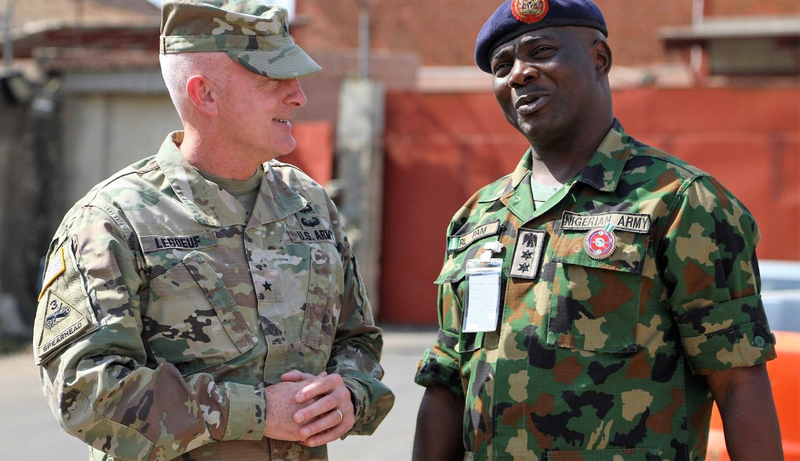
A former senior Nigerian army officer has cautioned against expectations that recently deployed U.S. troops would directly engage militants in combat, saying their role is likely to be limited to training, intelligence and technical support.
Major Gen. Ijioma N. Ijioma, a former director of operations at Nigeria’s Army Headquarters, spoke after the United States last week deployed a small team of troops to assist Nigeria in its fight against terrorism.
The head of U.S. Africa Command, Gen. Dagvin R. M. Anderson, said the team would bring “unique capabilities” as cooperation between both countries deepens, but did not disclose details about the size or scope of the mission. Nigerian officials have indicated the deployment will focus on intelligence gathering and enabling local forces to strike terrorist-linked groups.
Ijioma accused Nigeria’s political leadership of lacking the will to decisively confront banditry and insurgency, arguing that foreign involvement would not be necessary if authorities acted more firmly.
“If the 1967 Biafran insurgency had been handled with the same kid gloves being used today, there would have been a Biafra republic by now,” he said.
He stressed that only Nigerian forces could ultimately defeat militant groups, urging citizens to question why terrorists were being treated with what he described as leniency.
“The United States does not risk the lives of its soldiers for nothing,” Ijioma said, calling on Nigerians to ask what agreements or compensation underpinned the deployment.
He argued that insurgents have continued to operate boldly despite recent U.S. airstrikes and said Nigeria already has the capacity to carry out such operations independently.
“The strike the U.S. carried out in Sokoto and Kwara — is there anywhere our fighter jets cannot reach?” he said. “What we lack is political will.”
Ijioma questioned why Nigerian fighter jets were rapidly deployed to neighboring Benin Republic to quell an attempted coup, while attacks by bandits inside Nigeria persist.
“The U.S. troops are not going to fight Nigeria’s war,” he said. “Their role will be limited to training, intelligence and logistical support.”
He noted that Nigeria has previously collaborated with the U.S. military, recalling that American personnel were stationed at Nigeria’s Defence Headquarters during former President Olusegun Obasanjo’s first term. He said the arrangement was opposed by the then army chief, Victor Malu, and later ended.
Also commenting, a retired deputy inspector general of police, Goodwin Nwobodo, said Nigeria must play an active role for the collaboration to succeed, warning that a lack of trust could undermine the effort.
“In the past, the U.S. complained they could not work effectively with Nigerian troops because of concerns about intelligence sharing,” Nwobodo said. “If confidence exists this time, the collaboration can work.”
He stressed that Nigeria’s security challenges could not be solved by a small foreign force and that U.S. troops cannot operate independently under international law.
“They are here to support Nigeria,” he said. “Any expansion of their operation must be with the approval of Nigerian authorities.”
Nwobodo added that while bandits operate outside the law, foreign troops must respect Nigeria’s sovereignty, noting that any broader intervention would carry serious legal and political implications.








