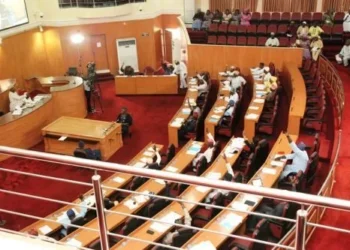
Nigeria’s Senate has announced an emergency plenary session for Tuesday following mounting public backlash over its passage of amendments to the Electoral Act that removed a provision mandating real-time electronic transmission of election results.
The decision was announced Sunday in a statement by the Clerk of the Senate, Emmanuel Odo, who said Senate President Godswill Akpabio directed lawmakers to reconvene for the sitting scheduled to begin at noon on Feb. 10.
The move comes amid threats of nationwide protests and possible election boycotts by labor unions, civil society groups and political activists who say the Senate’s action undermines electoral transparency and public trust.
Last week, the Senate passed the Electoral Act (Amendment) Bill 2026 but rejected Clause 60(3), which would have made it mandatory for presiding officers to electronically transmit results directly from polling units to the Independent National Electoral Commission’s results viewing portal in real time. Lawmakers instead retained the existing discretionary provision allowing electronic transmission after votes are counted and announced at polling units.
The Nigeria Labour Congress, the country’s largest labor union, warned Sunday that the Senate’s position could trigger mass action. In a statement, NLC President Joe Ajaero accused the Senate of creating confusion and weakening confidence in the electoral process.
“Nigerians deserve a transparent system where votes are not only counted but seen to be counted,” Ajaero said, adding that failure to mandate real-time electronic transmission could lead to protests or election boycotts.
A coalition of political activists operating under the banner of the Movement for Credible Elections also condemned the Senate’s decision, describing it as “democratic sabotage.” The group announced plans for a protest tagged “Occupy NASS” on Monday in Abuja.
In a statement, the coalition said rejecting mandatory electronic transmission amounted to choosing “opacity over transparency” and warned the decision could deepen electoral fraud ahead of the 2027 general elections.
Civil society groups, opposition figures and election observers have similarly criticized the amendment, calling it a setback to reforms introduced in the Electoral Act 2022, which was widely praised for strengthening election credibility.
Senate President Akpabio has defended the chamber’s action, insisting the Senate did not reject electronic transmission and saying lawmakers would not be intimidated by public pressure.
Meanwhile, the House of Representatives’ bipartisan conference committee on the bill is expected to meet its Senate counterpart this week to harmonize differences between the versions passed by both chambers.
A member of the committee, Saidu Abdullahi, confirmed the planned meeting, saying discussions would take place within the week. The committee is chaired by Lagos lawmaker Adebayo Balogun.
The controversy has intensified calls for legislative clarity following past disputes over discrepancies between polling unit results and figures uploaded to INEC’s portal during previous elections.
The pan-Yoruba socio-political group Afenifere also urged the National Assembly to reinstate mandatory real-time electronic transmission of results, warning that failure to do so could further erode public trust in democracy.
In a statement, Afenifere said the Senate’s rejection of the clause betrayed democratic principles and ignored global best practices, noting that the Supreme Court has previously ruled electronic transmission is not mandatory under existing law because it is not expressly provided for.
“By keeping electronic transmission optional, Nigeria is choosing opacity over trust,” the group said, adding that credible elections are essential to democratic stability.