






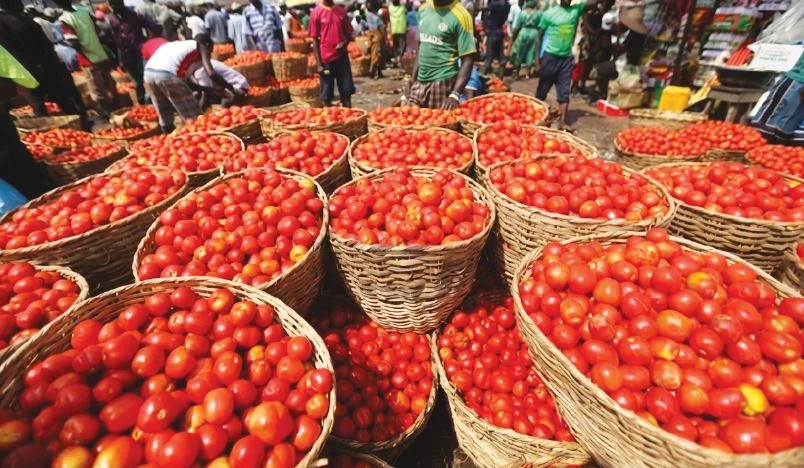
As Nigerians prepare for the Sallah celebration amid worsening economic hardship, soaring prices of tomatoes and peppers are placing fresh financial pressure on households, food vendors and traders across the country.
Once regarded as basic kitchen staples, the items have become increasingly expensive, forcing many families to reduce quantities or switch to cheaper alternatives.
At Mile 12 Market in Lagos, buyers and traders crowded stalls days before the festive period, haggling over rising prices.
A shopper, Rukayat Bello, said she had planned to buy enough food items for the celebration but had to cut back after discovering current prices.
“I could not believe that just five pieces of tomatoes would cost N1,000,” she said. “Everything is too expensive. We are just managing to cook what we can afford.”
Households adjust consumption
Many households now purchase tomatoes and peppers in smaller portions or mix fresh produce with cheaper or partially spoiled alternatives.
Esther Inyang, a mother of four, said rising costs forced her to reduce planned meals for her family.
“Buying tomatoes and peppers now feels like buying gold,” she said.
Market surveys show that a small plate of tomatoes now sells for between N500 and N1,000, while a paint bucket costs between N10,000 and N15,000 depending on location and quality.
A crate that previously sold for about N10,000 now goes for as high as N30,000 to N35,000 in some markets.
Shared buying on the rise
Many residents now pool money to buy food in bulk and share among households.
Lagos resident Queeneth Ojogbile said her contributions now yield far less than before.
“We contribute money and share, but what I got was very small compared to what I used to get,” she said.
She added that food items now last only a day in many homes, increasing household spending.
Traders blame supply and transport costs
Traders say rising wholesale prices, supply shortages and transport costs are driving increases.
Musa Yahaya, a trader, said prices rise almost weekly.
“A crate that used to sell for N25,000 to N30,000 now sells for N80,000 to N90,000,” he said.
He attributed the increases to transportation costs, spoilage during transit and insecurity on routes from northern producing states.
Another trader, Mustapha Abdulkadir, cited poor harvests and rising farming costs as contributing factors.
Transporters cite insecurity, fuel prices
Transporters said insecurity and high fuel costs have pushed up haulage prices.
Drivers said transporting goods from northern Nigeria to southern markets has become increasingly risky due to attacks and road delays.
A driver, Aliu Adamu, said transport costs have risen sharply.
“Before, we charged about N500,000. Now it is over N800,000 because of the risks involved,” he said.
Another driver, Bala Terkura, said fuel costs have made long-distance transport less viable.
Health concerns over spoiled produce
With rising prices, some consumers now buy slightly spoiled produce, raising health concerns.
Prof. Tanimola Akande, a public health physician, warned that rotten tomatoes and peppers may contain harmful bacteria and toxins.
He urged proper washing, storage and inspection before use.
Experts cite storage and policy gaps
Agricultural experts say poor storage infrastructure, seasonal production and weak policy implementation are driving price instability.
Prof. Matthew Adewumi, an agricultural economist, said Nigeria lacks adequate storage and processing facilities to stabilize supply.
He said weak implementation of agricultural policies continues to undermine food price stability.
Inflation adds pressure
The National Bureau of Statistics said inflation stood at 15.69% in April 2026, contributing to rising food costs.
Food inflation, which includes vegetables such as tomatoes and peppers, stood at 16.06% year-on-year.
Despite slight improvements compared with 2025 levels, analysts say households remain under significant cost-of-living pressure.
Families, vendors feel impact
Food vendors and restaurant operators say they are reducing portions and raising prices to survive.
“We are only trying to survive,” said a restaurant operator in Osun State, Bimpe Olowosibi.
A roadside vendor in Ogun State, Opeyemi Atilola, said ingredients that once lasted days now finish within hours.
Nutrition concerns
Health experts and international agencies warn that reduced consumption of fruits and vegetables could affect nutrition and health outcomes.
The World Health Organization recommends at least 400 grams of fruits and vegetables daily to reduce the risk of non-communicable diseases.
Government response
The Federal Ministry of Agriculture declined immediate comment on rising food prices, requesting that an official inquiry be submitted.








