






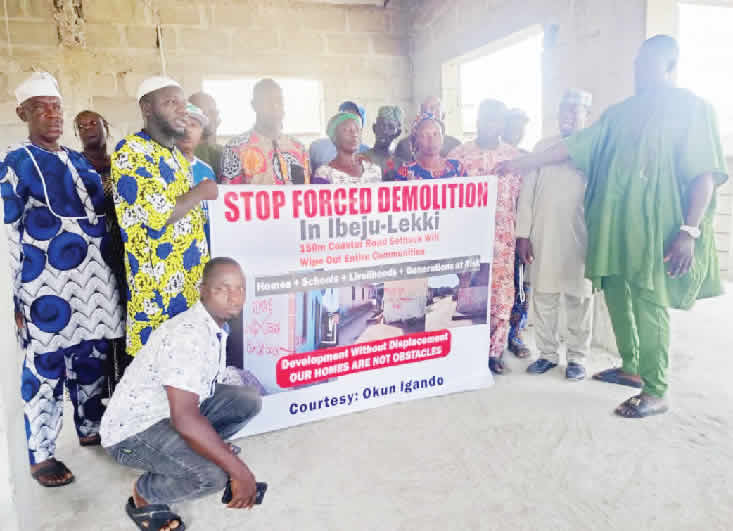
Some communities in the Ibeju-Lekki Local Government Area of Lagos State say a proposed 150-meter setback on both sides of the Lagos-Calabar Coastal Highway could wipe out long-established ancestral settlements, fueling fear of fresh demolitions and unrest.
Community leaders told reporters Thursday that residents were living in panic over what they described as a renewed plan by the Federal Government to enforce the setback along the highway corridor.
While praising President Bola Tinubu for initiating what they called a transformative legacy project, they said repeated realignments of the route had already led to the demolition of houses, shrines and ancestral landmarks in parts of the area.
They urged the Federal Ministry of Works and the Lagos State Government to clarify the project’s alignment and setback provisions, engage affected communities and consider granting a waiver for existing settlements.
Chief Adebayo Agbabiaka, speaking on behalf of the communities, said previous demolition exercises displaced entire villages, including multi-story buildings constructed before road infrastructure reached the area.
He said residents in earlier years transported building materials by boat through Epe and carried them into their villages, underscoring the effort invested in developing the communities.
Agbabiaka criticized compensation paid during earlier projects as inadequate. He said some families received between 9 million and 10 million naira, which he argued was insufficient to secure land in Ibeju-Lekki or relocate entire households.
He added that although compensation was paid for crops during the coastal road construction, some homeowners had yet to receive payment for demolished buildings.
“After all these sufferings and perseverance, some people entered our communities again and began marking houses for fresh demolition,” he said. “They marked 150 meters to the right and 150 meters to the left, despite the extent of destruction already suffered by the community.”
He said extending the setback would heavily affect the communities.
“These are our ancestral homes. If they are taken from us, where will we go?” he said. “We are not begging the government to relocate us. We are not even asking for compensation because, even if they compensate us, where are we expected to go?”
The Chief Odofin of Opo-Ijebu Kingdom, Kunle Balogun, also expressed concern over what he described as a fresh plan to claim additional land.
“Initially, the coastal road was meant to follow the shoreline from time immemorial,” he said. “After realignment and the destruction of shrines and ancestral homes of our forefathers, they are now saying they want to realign again. If they take 150 meters on the left and 150 meters on the right, what will be left of our communities?”
Another resident, Sharahu Ogunyemi, said the proposed setback would effectively erase the settlements, describing the land as communal property and appealing for a waiver.
A source in the Federal Ministry of Works, who spoke on condition of anonymity because he was not authorized to speak publicly, said the markings were carried out by the Office of the Surveyor General of the Federation.
The source said the government was not demolishing the marked buildings and that the exercise was intended to notify residents that the structures within 150 meters on either side were on federal land.
Sunday Adefarati, zonal director of survey coordination for the Office of the Surveyor General of the Federation in Lagos, declined to comment when contacted by phone, saying official matters could not be addressed over the weekend.
The Lagos-Calabar Coastal Highway is a flagship federal infrastructure project to construct a roughly 700-kilometer road linking Lagos in the southwest to Calabar in the south-south. The highway is expected to pass through Ogun, Ondo, Edo, Delta, Bayelsa, Rivers and Akwa Ibom states before ending in Cross River State.
Investors and homeowners along the corridor have raised concerns in recent months over property demolitions. Last month, a group known as the Project Affected Persons said they were directed to vacate properties within a strict 150-meter setback from the high-water mark or risk demolition without adequate compensation or prior notice.








