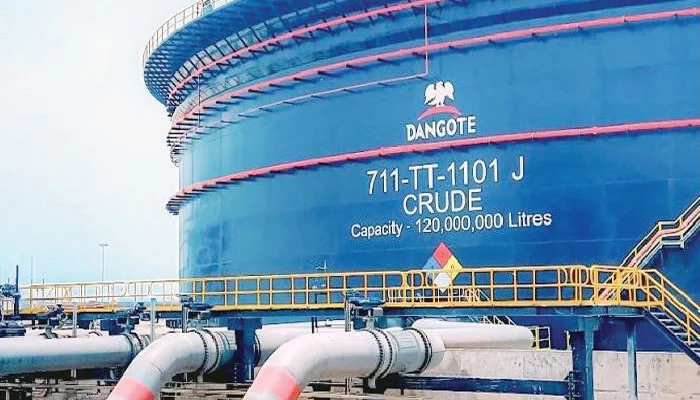
Nigerians across major cities are grappling with rising gasoline prices after the Dangote Petroleum Refinery increased its gantry price for Premium Motor Spirit, commonly known as petrol, to 995 naira per liter, pushing pump prices above 1,000 naira in several parts of the country.
Market surveys show petrol now sells between about 1,000 and 1,190 naira per liter depending on location and retail outlet, triggering higher transport fares and raising concerns about the rising cost of living.
Despite the increase, fuel supply remains largely steady, and there have been no widespread queues at filling stations. But motorists, transport operators and small business owners say the higher prices are placing additional strain on households already affected by inflation.
The latest price surge is linked to tensions in the Middle East involving Iran, the United States and Israel, which have disrupted global oil supply chains and driven crude prices higher.
The crisis escalated after joint U.S. and Israeli strikes on Iranian targets in late February 2026, followed by retaliatory attacks by Iran across the region and heightened tensions around critical energy infrastructure.
One key concern is disruption to shipping through the Strait of Hormuz, a narrow waterway between Iran and the Arabian Peninsula that handles nearly 20% of global oil and natural gas shipments.
Following the escalation, threats and attacks on vessels linked to the United States and Israel caused tanker traffic in the waterway to drop sharply, with many ships remaining anchored outside the strait because of security risks.
The disruptions have stranded millions of barrels of crude oil and refined products in the Gulf, raising fears of a global supply shortage.
Global benchmark Brent crude has already climbed above $90 per barrel, and analysts warn prices could rise further if the conflict continues.
Because global crude prices determine petroleum product costs, the shock has quickly filtered into fuel markets worldwide, including Nigeria.
Transport fares rise in Abuja
In Nigeria’s capital, commuters are bracing for higher transport fares as filling stations adjust pump prices above the 1,000-naira mark.
A survey showed most stations in Abuja now sell petrol between 1,052 and 1,105 naira per liter.
At stations operated by MRS Oil Nigeria, a retail partner of the Dangote refinery, petrol sold for about 1,060 naira per liter. A Nipco station along Airport Road sold it at 1,105 naira.
Other outlets, including Matrix Energy, Bovas, Shafa, Shema and A.A. Rano, adjusted prices to between 1,052 and 1,092 naira per liter.
A commercial driver, Daniel Ishyaku, who operates along the Federal Secretariat–Asokoro route, said he raised fares from 400 to 700 naira to offset fuel costs.
“Fuel is now more than 1,000 naira per liter. If I don’t increase the fare, I will run at a loss,” he said.
Some commuters complained that frequent fuel price increases were worsening the country’s cost-of-living crisis.
Prices climb higher in Lagos
In the commercial hub of Lagos, petrol sold for as much as 1,190 naira per liter at some stations on Saturday.
Prices across the city ranged from about 1,005 to 1,190 naira per liter.
At a Mobil station along Agege Motor Road in Mushin, petrol sold for 1,018 naira per liter.
Dispatch rider Augustine Akor said he had increased delivery charges because of the price rise.
“I delivered a package today and had to charge more because of the fuel increase,” he said.
At a station operated by the Nigerian National Petroleum Company Limited along Yaya Abatan Road, petrol sold for about 1,005 naira per liter.
A boutique owner, Chukwudi Anioke, said rising fuel prices could force businesses to increase prices of goods.
“I rely on generators because electricity supply is not stable. Now that petrol has increased again, we may have to raise prices,” he said.
Mixed prices across other states
In Kaduna State, petrol sold between 1,060 and 1,070 naira per liter at major stations, including outlets run by A.A. Rano, Rainoil and the Nigerian National Petroleum Company.
Residents said steady supply had prevented panic buying.
Similar prices were recorded in Taraba State, where petrol sold between 1,000 and 1,060 naira per liter in Jalingo and Wukari.
In Benin City, the capital of Edo State, petrol sold between 1,050 and 1,072 naira per liter at stations including Hifly and Raptors.
In Port Harcourt in Rivers State, prices ranged from about 1,050 to 1,075 naira per liter.
In Gombe State, prices were even higher, ranging from 1,080 to 1,250 naira per liter.
Motorcycle rider Ibrahim Musa said the increase had significantly reduced his earnings.
“Most of what we make now goes back into buying petrol,” he said.
Panic buying in some areas
Unlike most states, parts of Jigawa State saw panic buying as motorists rushed to stations fearing further increases.
In Dutse, petrol sold for between about 1,020 and 1,050 naira per liter.
Prices also climbed to around 1,150 naira per liter in Kano.
Residents in Sokoto State said prices had jumped from about 930 naira to between 1,050 and 1,100 naira per liter.
In Bauchi State, petrol sold between about 1,100 and 1,106 naira per liter.
Analysts say rising fuel prices typically trigger wider economic effects, as higher transportation and energy costs drive up food prices, production costs and the price of essential goods.
With petrol now selling above 1,000 naira per liter in several states, many Nigerians fear the economic ripple effects may only be beginning.