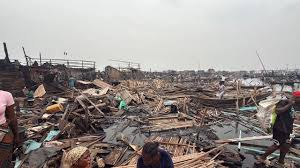
Psychiatrists have warned that the ongoing demolition of homes in Makoko, Lagos, could expose displaced residents to severe emotional distress, mental disorders and suicidal thoughts, urging authorities to treat the situation as a public health emergency.
The mental health experts said sudden displacement and loss of shelter often trigger depression, anxiety and other psychological crises, particularly among vulnerable groups such as children, the elderly, pregnant women and families with limited social support.
They said the emotional toll of forced eviction could be as devastating as its physical and economic consequences.
Residents displaced by demolitions across Lagos, including the recent exercise in Makoko, say they are struggling to cope as they attempt to resettle in different parts of the state, according to Nigerian Mirror.
Makoko, widely described as Africa’s largest floating slum, has seen families rendered homeless for weeks, with some nursing mothers and their babies forced to live in canoes. Reports indicate that several displaced children have missed routine immunisations, while pregnant women face hunger, anaemia and an increased risk of preterm birth.
Public anger intensified on Jan. 28, 2026, after police cracked down on residents protesting the demolitions in Makoko and other waterfront communities, including Oworonshoki, Owode-Onirin and Oko Baba. Human rights groups and activists criticised the Lagos State Police Command and the state government over the arrests and use of force.
The Lagos State Government, however, defended the demolitions, insisting that residents of Makoko and other waterfront settlements had been engaged for years and that the exercise was not carried out without notice.
A consultant psychiatrist at the Federal Neuropsychiatric Hospital, Aro, Abeokuta, Dr. Sunday Amosu, said a home represents more than a physical structure, noting that it is closely tied to safety, identity and a sense of belonging.
“When people suddenly lose their belongings, safety and shelter, especially with little or no notice, it has serious mental implications,” Amosu said. “Depression, anxiety and acute stress reactions can occur.”
He explained that demolition could trigger acute stress responses, including spikes in pulse and blood pressure, panic reactions and dangerous behaviour.
“Some people may even try to run back into the house, saying they would rather be demolished with it. That is an acute stress reaction resulting from trauma,” he said.
Amosu added that prolonged uncertainty about shelter and finances could lead to chronic anxiety, fear and hopelessness, which may progress into depression and grief reactions.
“It feels like a loss similar to bereavement,” he said. “There is also loss of identity and dignity, especially when people become dependent on others. This can lead to suicidal thoughts, social isolation and substance abuse as a coping mechanism.”
He warned that forced eviction also carries physical health risks, including injuries, infections, worsening of chronic illnesses and disruption of medication routines.
“For people with existing mental health conditions, demolition can act as a trigger for relapse,” he said. “Even those without prior mental illness may develop depression, adjustment disorders, psychosis or substance use disorders after prolonged trauma.”
Another consultant psychiatrist, Dr. Samuel Aladejare of Nidus Consultants, said losing one’s home could destabilise anyone, especially those without alternative accommodation.
“Most of the people affected have nowhere else to go, and that creates enormous psychological pressure,” Aladejare said. “The damage is not just individual; it is collective, affecting entire communities that shared identity, support systems and belonging for decades.”
He warned that the combined loss of homes and livelihoods could overwhelm some residents.
“Some people may not be able to cope with starting all over again,” he said. “For those who lose both their homes and workplaces, the burden can become unbearable and may lead to suicide.”
Aladejare urged displaced residents to seek immediate support from family members, religious groups and community networks, stressing the importance of accepting help.
He also called on the government to urgently provide relief.
“Temporary accommodation and emergency shelters should be created immediately to prevent a humanitarian and public health disaster,” he said. “Housing solutions must go hand in hand with mental health and social welfare support.”