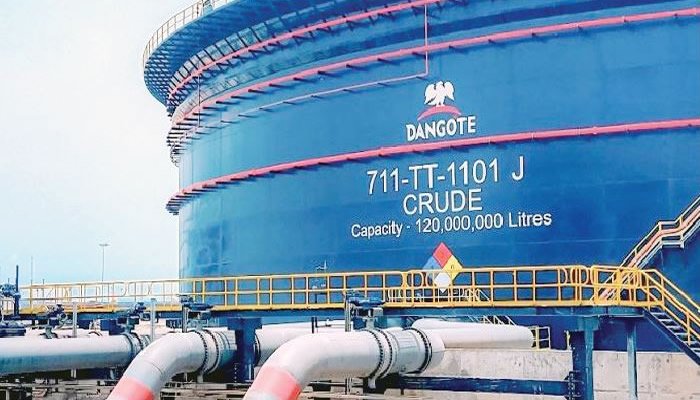
The Nigerian National Petroleum Company Limited (NNPC) has told the Federal High Court in Lagos that petroleum products from the Dangote Petroleum Refinery and Petrochemicals FZE are sold at “significantly high and fluctuating market prices,” warning that granting the refinery’s requests could lead to monopoly control of Nigeria’s downstream petroleum sector.
The position was contained in a counter-affidavit filed in opposition to Dangote refinery’s originating summons in Suit No. FHC/L/CS/857/2026 before the Lagos Judicial Division of the Federal High Court.
The NNPC urged the court to dismiss or strike out the suit, describing it as incompetent, premature, lacking in merit and an abuse of court process. It also said the refinery had no legal standing to institute the action.
The dispute stems from Dangote refinery’s challenge to petrol import licences issued by the Nigerian Midstream and Downstream Petroleum Regulatory Authority (NMDPRA) to marketers and the NNPC. The refinery had asked the court to void the licences, arguing they undermine domestic refining and violate regulatory provisions.
In its affidavit, the NNPC argued that the refinery’s claims of monopoly were unfounded and warned that restricting imports could destabilise fuel supply and national energy security.
“The plaintiff’s petroleum products are already sold at significantly high and fluctuating market prices, dictated by its commercial interests,” the company said.
It also accused the refinery of engaging in forum shopping, noting that it had previously filed a similar suit in Abuja before withdrawing it and refiling in Lagos.
NNPC further argued that there was no credible evidence showing that Dangote refinery alone could meet Nigeria’s total fuel demand.
“There is no credible, independent, or verifiable evidence before this Honourable Court establishing that the plaintiff presently satisfies the petroleum product demands of Nigeria,” it said.
The company said Nigeria’s fuel supply chain depends not only on refining capacity but also on logistics, storage, distribution, transport and strategic reserves.
It warned that relying on a single supplier would expose the country to serious risks.
“Reliance on a single supplier within the petroleum industry poses grave risks to national energy security,” the affidavit stated.
NNPC added that any disruption at the refinery could trigger nationwide shortages if import channels were restricted.
It also defended the continued issuance of import licences, saying they were lawful under the Petroleum Industry Act (PIA) and necessary for market stability.
According to the company, Section 317(8) of the PIA gives regulators discretionary power on backward integration policy and does not ban imports.
“Section 317(9) of the Petroleum Industry Act expressly contemplates the issuance of import licences to companies with active local refining licences or proven track records in international crude oil and petroleum products trading,” it said.
NNPC also denied allegations that government agencies deliberately sabotaged the refinery or denied it crude oil supply, saying allocations were determined by commercial, operational and security considerations.
It maintained that regulators had not frustrated Dangote refinery’s operations and that all actions were taken in line with national interest and the PIA.
Oil marketers under the Petroleum Products Retail Outlet Owners Association of Nigeria (PETROAN) supported the NNPC’s position, arguing that competition was essential to prevent price exploitation and ensure supply stability.
PETROAN President Billy Gillis-Harry said a liberalised market would help ensure availability, price moderation and efficiency, while warning against monopoly control.
He said Nigeria’s downstream sector must remain open to multiple operators to prevent supply shocks and protect consumers.
The Crude Oil Refiners Association of Nigeria (CORAN) also weighed in, questioning the continued importation of petroleum products despite local refining capacity.
CORAN argued that investment in local refining should be prioritised over imports, saying commitment to the sector should be measured by capital investment and long-term exposure.
The legal battle marks the latest clash between Dangote refinery and oil sector regulators since the facility began operations. The dispute centres on fuel importation, domestic refining capacity and implementation of the Petroleum Industry Act following deregulation of the downstream sector.