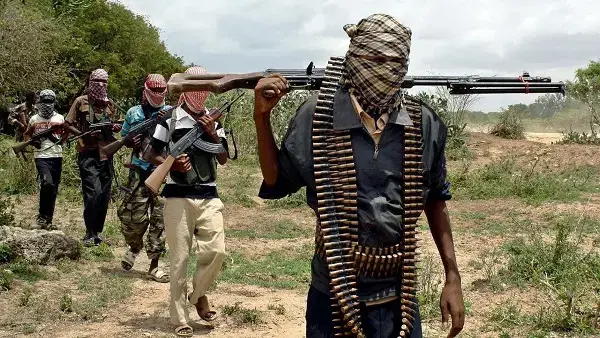
Residents of boundary communities in Nasarawa State and recent security disclosures in Kogi have revealed what they describe as a widening network of forest corridors, transit routes and temporary camps allegedly used by terrorists and bandits across the North-Central region.
The reports come amid ongoing attacks and rising tensions between Nasarawa and Benue communities over the origins of armed groups responsible for killings and mass displacement in border areas.
While the Nasarawa State Government has repeatedly denied harbouring criminal elements, locals say armed groups move freely through forest routes linking Nasarawa to Benue. In Kogi, authorities have acknowledged that forests in some areas are increasingly being used as hideouts by bandits displaced from northern states by military operations.
Locals say porous boundaries and dense forest belts across Nasarawa, Benue, Kogi, Niger and Kwara states have gradually evolved into strategic corridors for armed groups, enabling them to launch attacks, regroup and retreat with minimal resistance.
“Routes are not hidden,” residents say
Chief Denen Gbongbon, president of the United Farmers Association in Kadarko, Keana Local Government Area, told Vanguard that communities in Obi, Keana and Doma local councils have long served as transit points and temporary camps for armed groups moving toward Benue.
“For a long time now, Obi, Keana and Doma have been serving as transit routes and even temporary camps for these bandits,” Gbongbon said. “The routes are very clear. They are not hidden.”
He alleged that the Akala forest in Obi LGA functions as a major staging ground, connecting to Keana through a series of contiguous communities. Gbongbon described movement patterns including the use of abandoned railway corridors leading into Benue.
Eyewitness accounts
Gbongbon said local farmers frequently witness armed groups moving in groups, sometimes openly carrying weapons, other times transporting cattle or riding motorcycles. He added that residents provide intelligence to security agencies, but said follow-up has been inadequate.
“Government is fully aware. We have written repeatedly to the Nasarawa State Government, local governments, the governor and security agencies. How can the government pretend not to know?” he asked.
Allegations against local chiefs
Gbongbon accused some local chiefs of complicity, alleging that land sales to armed groups facilitated their presence and that traditional rulers misled security operatives. He cited the arrest of an Ardo in Kadarko in connection with the June 2025 Yelwata killings, in which 26 rifles were reportedly recovered. Efforts to reach the accused traditional rulers were unsuccessful.
Humanitarian toll
The crisis has caused mass displacement. Gbongbon said 14,318 people from Kadarko communities are registered as internally displaced, with residents taking shelter in schools, churches and marketplaces.
Sampson Akaa of Umaraye village, Keana LGA, recounted a personal tragedy in which four people were killed and one remains missing after returning home from an IDP camp.
Kogi forests as a strategic haven
Authorities in Kogi State acknowledged that forests have become sanctuaries for armed groups displaced by military operations in northern states. Governor Ahmed Ododo said some bandit leaders relocated to Kogi forests, promising proactive operations.
Kogi Commissioner for Information, Kingsley Fanwo, described a “hibernation cycle” in which gangs attack elsewhere and retreat into forests to regroup. Joint air and ground operations have been conducted in several LGAs, resulting in arrests and the recovery of arms.
Despite efforts, kidnappings and attacks persist along major corridors, disrupting economic and educational activities.
Regional challenge
Security analysts say forests linking Nasarawa, Benue, Kogi, Niger and Kwara states form an interconnected belt exploited by armed groups. They warn that military pressure in one state without coordinated regional action risks merely displacing the threat.
Residents, however, say immediate security is paramount. “We are tired,” Gbongbon said. “We just want our people to go back to their farms and live without fear.”