






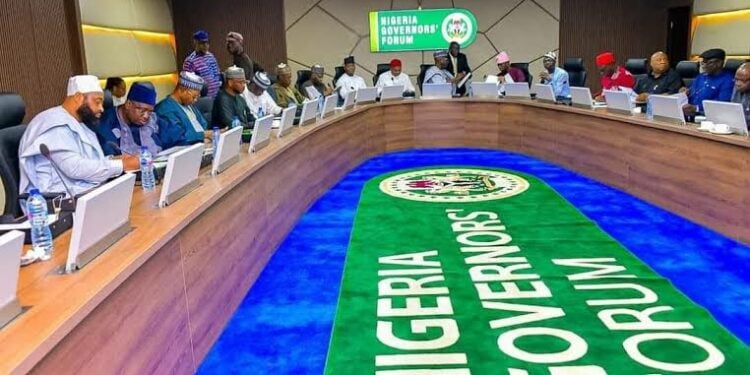
Nigerian state governments received an estimated 9 trillion naira ($6 billion) in federal revenue allocations in 2025, but labour unions, civil society groups and opposition parties say the surge has not translated into meaningful improvements in citizens’ welfare.
Data from the Federation Account Allocation Committee show that direct allocations to states rose sharply in 2025, fuelling criticism that higher revenues have been absorbed by weak governance, misplaced priorities and corruption rather than improved public services.
According to Federation Account figures published by the National Bureau of Statistics and analysed by The PUNCH, states received 7.315 trillion naira in direct FAAC allocations in 2025, up from 5.186 trillion naira in 2024 — an increase of about 41%.
When constitutionally mandated 13% derivation revenue is included, total inflows attributable to states climbed to about 8.934 trillion naira, compared with 6.533 trillion naira a year earlier.
The revenue increase occurred amid a broader expansion in federal disbursements. Total FAAC allocations to all three tiers of government rose from 15.259 trillion naira in 2024 to 21.897 trillion naira in 2025.
Despite the growth, states’ relative share declined slightly as allocations expanded across all tiers. Including derivation revenue, state-linked inflows accounted for about 40.8% of total FAAC disbursements in 2025, down from roughly 42.8% in 2024.
Monthly data show steady improvement in state allocations throughout 2025, peaking at 727.17 billion naira in October. By midyear, states had already received more than 3.32 trillion naira, easing short-term liquidity pressures for wage payments and debt servicing.
Derivation payments to oil-producing states also rose to 1.619 trillion naira in 2025, up more than 20% from the previous year.
Organised labour said the additional funds have failed to improve living standards.
“Very few states are doing well in terms of how they deploy what they receive,” Nigeria Labour Congress Assistant Secretary-General Onyeka Christopher said. “The idea behind federal allocations is to bring government closer to the people, but that has not happened in many states.”
Civil society groups echoed the criticism, accusing state governments of mismanaging the inflows and failing to show tangible development.
“There is no physical, verifiable evidence that these monies are touching lives,” said Auwal Musa Rafsanjani, executive director of the Civil Society Legislative Advocacy Centre. “Healthcare, electricity, infrastructure and agriculture remain largely unimproved.”
Economists say the surge has expanded fiscal space for states but warned that heavy dependence on federal transfers remains a structural weakness.
“These revenues are volatile and largely outside state control,” said Ayodeji Ebo, managing director of Optimus by Afrinvest. “Over time, this discourages innovation and the development of sustainable internal revenue sources.”
A BudgIT report released this year showed that more than 30 states rely on FAAC allocations for over 60% of their recurrent revenue, with 21 states depending on the federation account for more than 70%.
BudgIT officials warned that rising federal inflows were reducing incentives for states to expand internally generated revenue, noting that the share of IGR in recurrent revenue fell between 2023 and 2024.
Opposition parties across several states said the higher allocations have not eased hardship.
In Lagos, African Democratic Congress chairman George Ashiru said inflation had wiped out gains from increased revenue, citing sharp rises in rents and the cost of living.
In Sokoto, the Peoples Democratic Party said development was concentrated in the state capital while rural areas were neglected. Similar concerns were raised by opposition parties in Kano, Plateau, Bauchi, Zamfara, Kebbi and Gombe states.
Some ruling parties rejected the criticism. In Bauchi State, the Peoples Democratic Party said progress was evident in salary payments, road construction and renovations of schools and hospitals.
Analysts say the additional 2.4 trillion naira received by states in 2025 — nearly half of what they received in total in 2024 — has heightened expectations for better governance.
“As allocations rise, so do expectations,” said development economist Aliyu Ilias. “Without accountability and incentives to grow local revenue, higher transfers alone will not improve living standards.”
As federal revenues continue to climb, debate is intensifying over whether Nigeria’s states are converting the windfall into tangible development or missing another opportunity to improve citizens’ lives.








