






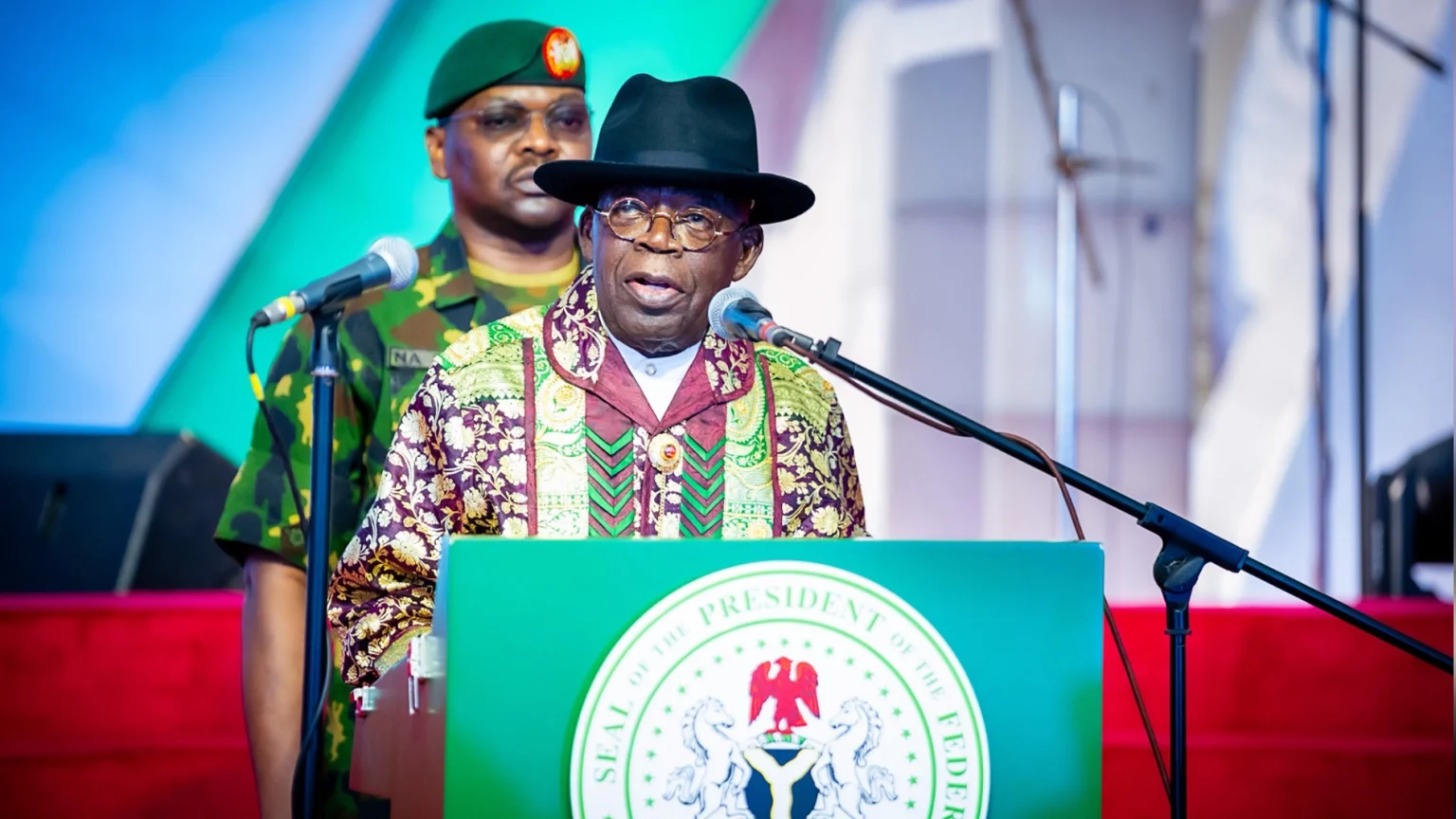
President Bola Ahmed Tinubu marked Nigeria’s 2026 Democracy Day by celebrating 27 consecutive years of civilian rule, defending his administration’s economic and security reforms, and announcing national honors for dozens of pro-democracy activists, journalists and military officers who contributed to the June 12 democratic struggle.
In his national address, Tinubu described Nigeria’s democratic journey since May 29, 1999, as the country’s longest uninterrupted period of civilian governance.
“Today, we celebrate not only democracy but also the enduring Nigerian spirit,” Tinubu said, noting that political disagreements are now largely resolved through constitutional institutions rather than violence.
Among those honored were former Guardian editors Lade Bonuola and Femi Kusa, alongside several journalists, civil society activists and democracy advocates. The president also recognized military officers he described as “soldier-democrats” for their roles during the June 12 struggle.
Tinubu called on stakeholders to ensure peaceful and credible governorship elections in Ekiti and Osun states and urged the Independent National Electoral Commission, security agencies and political parties to protect the integrity of the electoral process.
He also appealed to the National Assembly, judiciary, media and civil society organizations to continue safeguarding democratic institutions, stressing that criticism and disagreement remain vital elements of democracy.
Addressing security concerns, Tinubu expressed concern over the recent abduction of children in Oyo and Borno states, describing the incidents as a shadow over the Democracy Day celebration.
The president said his administration had declared a security emergency, approved the recruitment of more than 50,000 police officers and increased military recruitment to strengthen national security.
According to him, the 2026 budget allocates N5.41 trillion to defense and security, the highest such expenditure in Nigeria’s history. He said military operations have intensified against terrorist groups, including operations targeting the Islamic State West Africa Province in Borno State.
Tinubu said terror-related deaths have declined significantly since 2015 and reported that more than 13,000 terrorists were neutralized over the past year, while over 124,000 fighters and their dependents surrendered through Operation Safe Corridor since 2023.
He warned bandits, kidnappers and terrorism sponsors to surrender or face decisive government action, stressing that criminality transcends ethnic and regional identities.
Reflecting on the significance of June 12, Tinubu paid tribute to late business mogul and presumed winner of the annulled 1993 presidential election, Chief M.K.O. Abiola, as well as other democracy activists whose sacrifices helped secure Nigeria’s democratic freedoms.
Turning to the economy, the president said economic freedom represents the defining challenge of the current generation, arguing that democracy must translate into improved living standards, employment opportunities and economic prosperity.
Tinubu defended reforms introduced since 2023, saying they were necessary to address fiscal pressures, weak investor confidence and economic instability inherited by the administration.
He said the reforms have increased government revenues, strengthened fiscal transparency and attracted investments across agriculture, energy, manufacturing, technology, mining, transportation and the creative sector.
On energy, Tinubu highlighted improvements in domestic refining capacity and reforms in the electricity sector, including implementation of the Electricity Act, which grants states greater authority over electricity generation, transmission and distribution.
He also announced plans to raise a N4 trillion bond to settle verified legacy debts in the power sector and highlighted ongoing rural electrification projects supported by international development partners.
The president cited agricultural and export initiatives, including plans to deploy 10,000 tractors over five years and a reported 21% increase in non-oil exports.
Despite those developments, Tinubu acknowledged that many Nigerians continue to face economic hardship and said his administration remains focused on reducing inflation, increasing food production, creating jobs and improving living standards.
He also reiterated support for financial autonomy for Nigeria’s 774 local government councils, arguing that stronger grassroots governance is essential to addressing insecurity and promoting development.
As part of the Democracy Day celebrations, Tinubu announced the renaming of the Institute of Petroleum Studies in Kaduna as the General Shehu Musa Yar’Adua University of Geological Sciences and Engineering Technology.
Concluding his address, the president called for renewed commitment to national unity, democratic governance and economic prosperity.
Meanwhile, the African Democratic Congress (ADC) challenged the administration’s record, arguing that democracy should be measured by improvements in citizens’ welfare, security and opportunities rather than the duration of civilian rule.
In a Democracy Day statement signed by National Publicity Secretary Bolaji Abdullahi, the opposition party said many Nigerians remain dissatisfied with governance, citing insecurity, economic hardship and declining public trust in institutions.
The ADC maintained that democracy must deliver tangible benefits, including safety, economic opportunity and accountable leadership.
Supporting that position, a new NOIPolls survey found that 72% of Nigerians are dissatisfied with the country’s democratic system. The survey identified insecurity, poor governance, economic hardship and inadequate democratic dividends as the leading reasons for public discontent.
According to the poll, insecurity and poor leadership were jointly rated as the country’s most significant challenges, while security received the poorest assessment among major government sectors.
Also commenting on Nigeria’s democratic journey, Chief Executive Officer of the Centre for the Promotion of Private Enterprise, Dr. Muda Yusuf, said the country remains heavily dependent on imports despite nearly three decades of democratic governance.
Yusuf argued that Nigeria’s manufacturing sector has failed to achieve significant transformation, with its contribution to gross domestic product remaining relatively stagnant. He called for greater emphasis on industrialization, value addition and production-driven growth to strengthen the economy and reduce reliance on imports.








