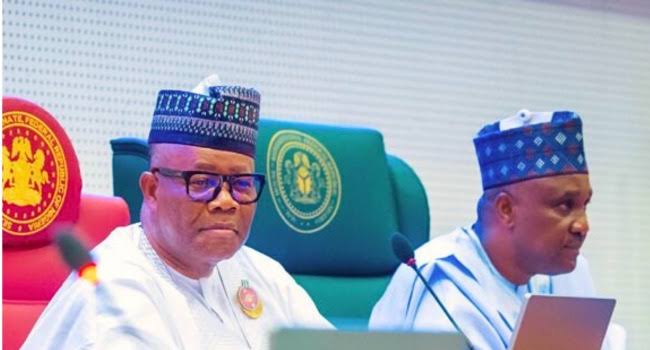
Nigeria’s Senate has amended its Standing Rules to tighten eligibility for leadership positions, a move that could limit the chances of incoming lawmakers — including outgoing governors — seeking top offices in the 11th National Assembly.
The changes, adopted Tuesday after a closed-door session lasting about three hours, revise Orders 4 and 5 to restrict presiding and principal offices to ranking lawmakers with defined legislative experience.
The move is widely seen as pre-emptive, coming amid growing interest from political heavyweights positioning to enter the Senate in 2027 and contest for offices such as Senate president and deputy senate president.
Under the revised Order 4, the chamber reinforced a hierarchy for the emergence of presiding officers, prioritizing former Senate presidents, former deputy Senate presidents, former principal officers, serving senators with at least one term, and former members of the House of Representatives. First-time senators rank last.
Order 5 introduces a stricter condition, stating that only senators who have served at least two consecutive terms immediately preceding nomination are eligible to contest for principal offices.
The implication is that senators-elect who were not members of both the 9th and 10th National Assembly would be ineligible for key leadership roles in the 11th Assembly.
Presiding offices include Senate president and deputy Senate president, while principal offices cover positions such as Senate leader, deputy leader, chief whip, minority leader and others.
The amendments come as political activity intensifies ahead of the 2027 general elections, with several governors completing their constitutionally allowed two terms and seeking to transition to the National Assembly.
Among those expected to leave office in 2027 are Babajide Sanwo-Olu, Dapo Abiodun, Seyi Makinde and Bala Mohammed, alongside several others across the country.
In Imo State, political maneuvering has intensified around Gov. Hope Uzodimma, who is being positioned by members of the All Progressives Congress for the Imo West senatorial seat.
Party leaders in the state have backed Uzodimma as a consensus candidate, while incumbent Sen. Osita Izunaso is also reportedly seeking a return to the chamber.
Former Gov. Rochas Okorocha has also obtained nomination forms, signaling his intention to contest the seat.
The developments reflect broader political realignments as governors and other influential figures seek to retain relevance after leaving office.
The rule changes are seen as an effort by the Senate to preserve institutional hierarchy and prevent first-time lawmakers — including politically influential newcomers — from immediately occupying key leadership positions.
For prospective entrants, the amendments underscore that legislative experience, rather than political influence outside the chamber, will determine eligibility for leadership in the next National Assembly.